Micro-Drip Irrigation
Most apartment balconies lack an exterior hose spigot. Dragging watering cans through the living room leads to spills and inconsistent moisture cycles. Low-voltage solar micro-drip networks solve this problem completely.
The Reservoir & Solar Pump Architecture
A balcony micro-drip system operates independently of mains plumbing. A discreet 20-to-30-liter reservoir disguised within an outdoor bench stores clean water. An elevated solar pump powers a 4 mm micro-bore delivery line along the planter perimeter.
Pressure-compensating emitters deliver exact doses (e.g., 2 liters per hour) straight to the root zone, preventing moisture loss from midday wind evaporation.
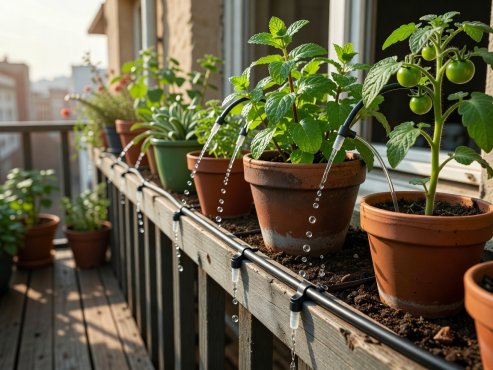
Irrigation Regimes by Plant Category
| Plant Group | Emitter Type | Flow Rate | Frequency (Summer) | Critical Notes |
|---|---|---|---|---|
| Fruiting Vegetables (Tomatoes/Peppers) | In-line drippers (2 per pot) | 2.0 L/h | Twice daily (7am / 7pm) | Even moisture prevents blossom end rot |
| Leafy Greens & Strawberries | Micro spray stakes | 1.5 L/h | Daily at dawn (8 mins) | Keep surface roots hydrated |
| Woody Mediterranean Herbs | Adjustable dripper | 0.5 L/h | Every 3 days | Thrives on cyclical dry-down periods |
| Vertical Living Walls | Continuous porous soaker line | 1.0 L/m | Daily (5 mins morning) | Top tiers require double line run |
Anti-Siphon Valves
Always install an inline anti-siphon check valve. If the water line dips lower than the reservoir height, a siphon will continuously empty the tank onto your deck.
Rain Sensor Pausing
Modern micro-controllers feature miniature moisture sensors. When seasonal downpours strike, watering cycles automatically pause for 24 hours.
Winterizing Tubing
Before the first November freeze, flush the system with air and uncouple the pump. Water trapped in 4 mm tubes can rupture emitters upon freezing.